Your business shouldn’t have to change how it works to fit its CRM.
Off-the-shelf CRMs like HubSpot or Pipedrive fit most businesses well enough. When they don’t — when your workflow is your competitive advantage — we build the CRM around it, not the other way round.
HubSpot or Pipedrive is often the right answer.
If your workflow is close to what an established CRM already offers, buy it. We’ll tell you that on the first call and refer you to a good setup partner if you don’t already have one.
Custom is not a status purchase. It’s an engineering decision that only makes sense when the shape of your business genuinely doesn’t fit what off-the-shelf gives you — and the cost of forcing the fit is greater than the cost of building.
Build the pipeline. Attach the modules.
The six-stage pipeline below is deliberately generic — every business we work with runs something close to it. Click the modules below to see which stages they plug into. The connections light up as you go.
Trigger-based workflows across every stage — routing, reminders, hand-offs. What used to be a manual copy-paste becomes an event.
Templated + one-off email, sent from your domain, tracked in the record. Sequences fire on stage change; nobody drops through the cracks.
Six signals. Any one of them and it’s worth a conversation.
- 01Complex workflows
Your process branches, loops, escalates. Off-the-shelf can’t model it without so many workarounds that the tool becomes the problem.
- 02Industry-specific processes
Regulated care, professional services, construction, healthcare — sectors where compliance is a workflow, not a checkbox.
- 03Multiple teams, one deal
Sales, delivery, finance and support all touching the same record with different permissions and different needs.
- 04Unique customer journeys
What matters at the point of sale is different from what matters at renewal. A generic CRM makes both feel like the same funnel.
- 05Disconnected systems
You’re running six SaaS tools and Airtable to hold it all together. Custom removes the glue layer entirely.
- 06Heavy manual admin
The team spends more time updating the system than using it. A custom build gives that time back to actual work.
Custom means outcomes, not features.
- Sales pipeline
The whole deal lifecycle in one record. Not a bolt-on to a marketing tool.
- Delivery workflows
Post-win execution. Assignments, milestones, client-facing progress.
- Customer records
One record, all the history. Sales, delivery, support, finance — every event.
- Document generation
Proposals, contracts, invoices — generated from the record, saved back to it.
- Automation rules
Stage-change triggers, SLA timers, escalations. Never a manual reminder again.
- Reporting + BI
Live dashboards driven by the source of truth — not a nightly export.
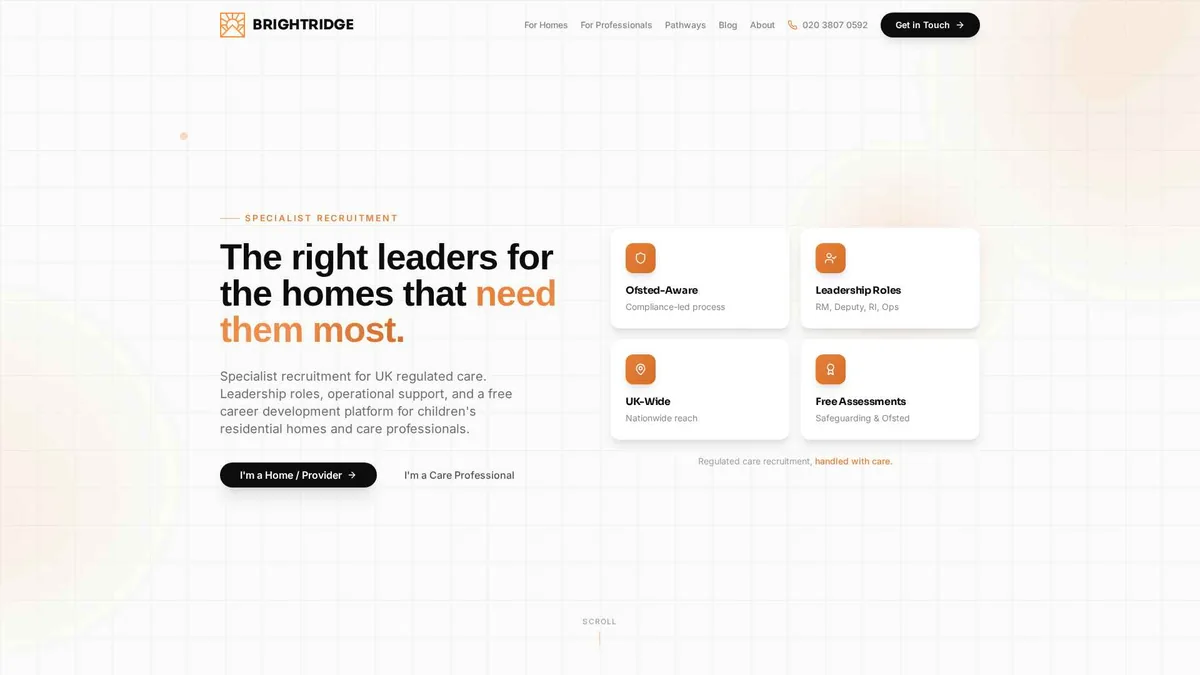
Brightridge — a system built around a workflow the industry didn’t have.
A UK regulated-care recruiter needed more than a CRM: two-sided dashboards, Ofsted-aware application flow, a free learning hub for care professionals, and an AI-driven interview coach — all sitting on one platform, one record.
Off-the-shelf recruitment tools would have made them look like every competitor. Custom let them build the thing the industry was missing.
See the Brightridge case studyStart with the critical workflow. Grow from there.
A custom build doesn’t mean rebuilding every tool your business runs on. It means replacing the single workflow that’s doing the most damage — the one held together with spreadsheets, Slack messages and hope.
Phase 1 focuses there. Phase 2 grows into the next-most-painful thing. Some businesses stop after phase 2 because everything else works fine off-the-shelf. That’s a good outcome — not a failure.
A meaningful phase-1 CRM typically sits in a £15,000–£35,000 range. Discovery precedes everything and is quoted up front.
Show us the spreadsheet.
We’ll tell you honestly whether it needs replacing — or whether a smarter use of what you already own gets you 90% of the outcome for 20% of the cost.